This document outlines backup power strategies for essential utilities and appliances, with a focus on maintaining livability and home infrastructure health during power outages, such as the January 2024 outage in Portland, Oregon. It covers key utilities such as heat, water and food refrigeration, as well as consideration of Portland General Electric's (PGE) Time of Day energy shifting using battery storage.
Table 1.1 Power Outages in winter 2023/24
Start | End | Duration | Cause (per PGE) |
Jan 18, 7:22pm* | Jan 19, 9:08pm | 26 hours | Tree on line |
Jan 13, 7:34am | Jan 17, 7:15pm | 108 hours | Major wind/snow storm |
Dec 26, 6:01pm | Dec 27, 3:15am | 9 hours | High winds |
*Note: The Jan 2024 power outage spanned seven days with 24 hours of power on day five.
During the January 2024 storm, home heating became critical due to a combination of no power and below freezing temperatures. Heat is essential to protect water pipes from freezing. The natural gas forced-air furnace is the primary and most comprehensive heating method, requiring 120V with 1,250W for startup and 1,150W continuous power for stage 2 heating.
Refrigeration is essential to preserve perishables. The kitchen refrigerator draws 1,265W on startup and 256W continuous. The garage refrigerator and chest freezer require startup power of 550W and 400W, and continuous power of 146W and 115W, respectively.
Water is crucial for drinking, cleaning, and toilet flushing. Bottled water can be used for consumption and flushing. The well pump, however, presents a significant challenge, requiring 240V with a 4,670W startup and 2,047W continuous power.
In the event where heating is not possible or abandonment due to damage or unsafe conditions with freezing temperatures, it is essential to disconnect the water circulator, turn off the main water valve at the pump house, and drain the pipes.
The home is heated by an International Comfort Systems/Honeywell dual-stage natural gas forced-air furnace (model T9MPV125L20A1). The label maximum input is 11.2A at 115V, equating to 1,288W. The furnace operates in two stages:
The furnace measured 1,260W for startup.
A 1000Wh battery powers the furnace for about an hour, raising the home temperature from 45°F to 55°F when the outside temperature is 24°F.
Alternatives include using a fireplace or a propane heater for smaller spaces. A full stack of firewood provides approximately three hours of heat, with residual heat from the masonry maintaining a temperature of 45°F in the crawlspace, where the insulated water pipes are located. After three days of fire tending, the house temperature dropped at night but never below freezing, whereas many neighbors experienced frozen pipes.
For the well head in the insulated pump house, a 60W bulb usually provides enough heat, even during sub-20°F conditions. A backup ceramic heater connected to an Easy Heat EH-38 thermostat (38°F to 50°F) offers additional heating. If there is no power, a propane heater (Heater Buddy) can increase the pump house temperature from 39°F to 75°F within an hour, with the outside temperature at 20°F.
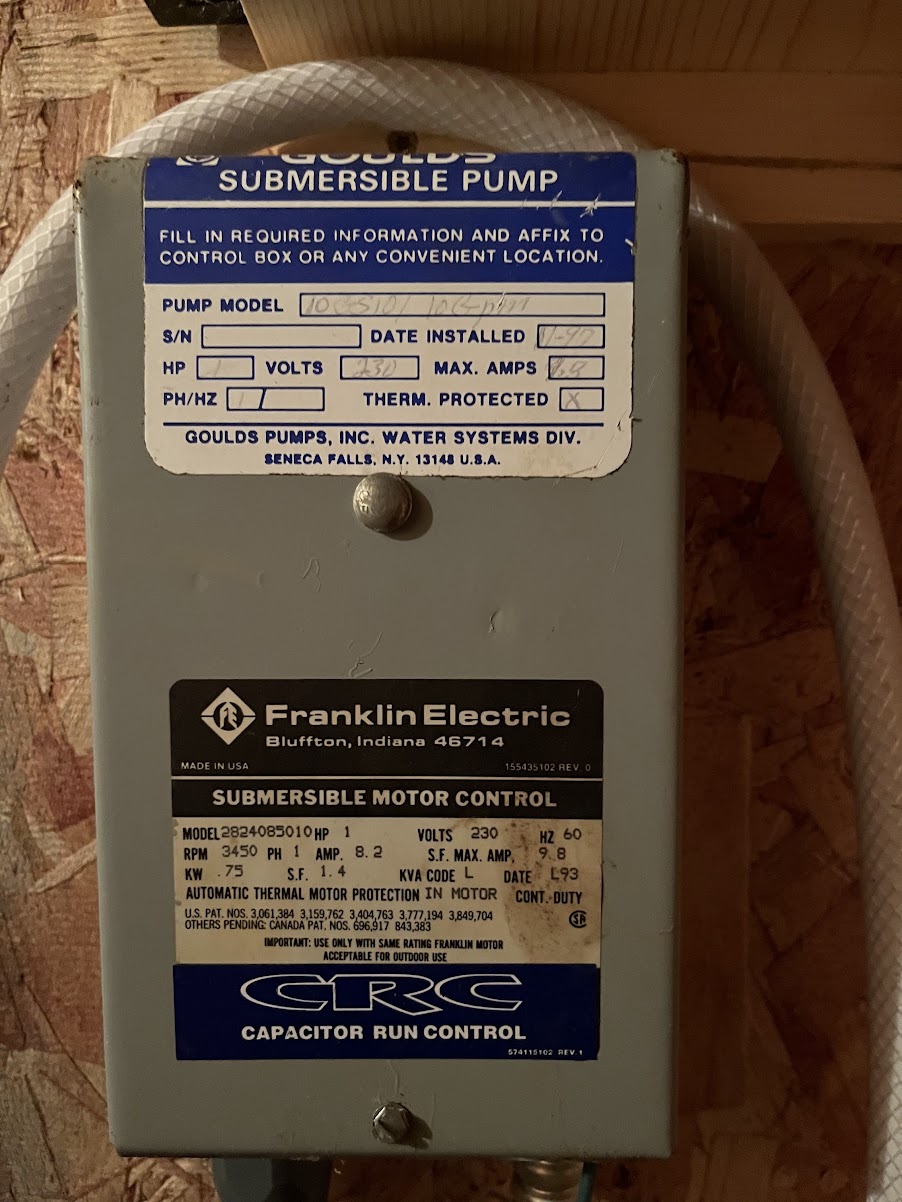
The well pump is a Goulds Submersible Pump 10GPM powered by a Franklin Electric motor control (model #2824085010). It operates at 1HP, 230V, 8.2A (1,886W), with a startup power of 4,670W and continuous power of 2,057W. The pump runs to maintain 40psi of pressure.
The well pressure tank is a Flexcon FlexLite FL28 with a 82-gallon capacity, capable of drawing down 26.5 gallons at 40/60psi.
The water heater is a 50-gallon natural gas unit, which does not require electricity to operate with an always-on pilot light.
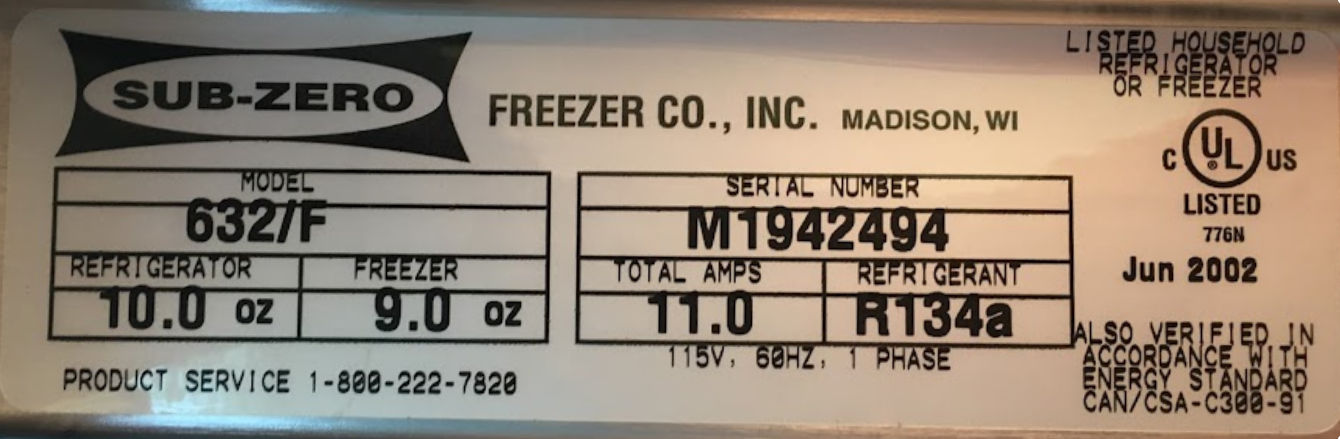
The kitchen refrigerator is a Sub Zero 632 with an observed startup power of 1,240W and continuous power ranging from 118W to 285W. The unit has two compressors, one for the refrigerator and one for the freezer. There are three A15 8W LED bulbs in the freezer and four in the refrigerator, adding 24W or 32W respectively when the door is opened.
The garage Whirlpool refrigerator uses 146W of power with a startup of 544W. The garage chest freezer uses 115 W of power with a startup of 400W.
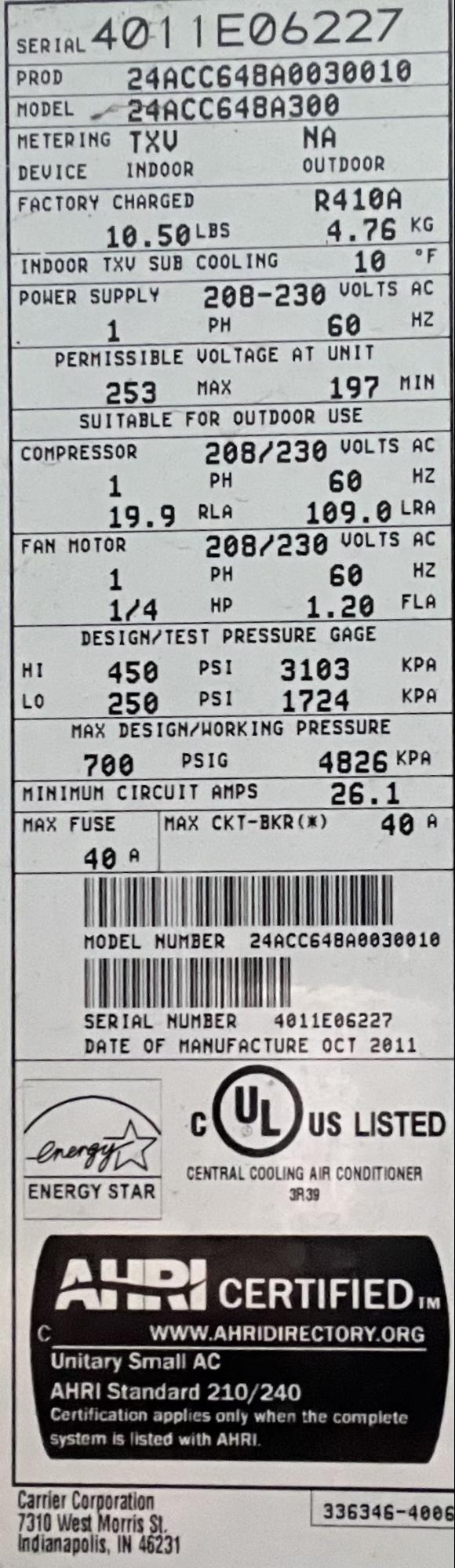
Although not a critical utility, the air conditioner draws significant power and should be considered for Time of Day pricing in the summer. The air conditioner is a 4 ton 16 SEER single stage Carrier Performance model number 24ACC648A0030010 on a 40A breaker. Rated Load Amps (RLA) that is the maximum current draw of the device is 19.9A or 4,577W at 230V. Locked Rotor Amps (LRA) or startup power is 109.0A or 25,070W at 230V. Using a soft start motor starter (ICM870-32A) reduces the startup surge to 7,521W.
Available energy sources are electricity and natural gas supplemented by wood, gasoline, propane and LFP batteries. Wood is abundant as large branches fall throughout the year but needs to be cut, collected, split, dried and covered. Gasoline is widely available and non ethanol fuel (clear) is available at the North Plains Chevron. An empty 100lb propane tank is available from the Hillsboro Costco for $140 and can be filled most economically at Ferrell Gas by the Hillsboro Winco. LFP batteries are approximately $134-$290 per kWh.
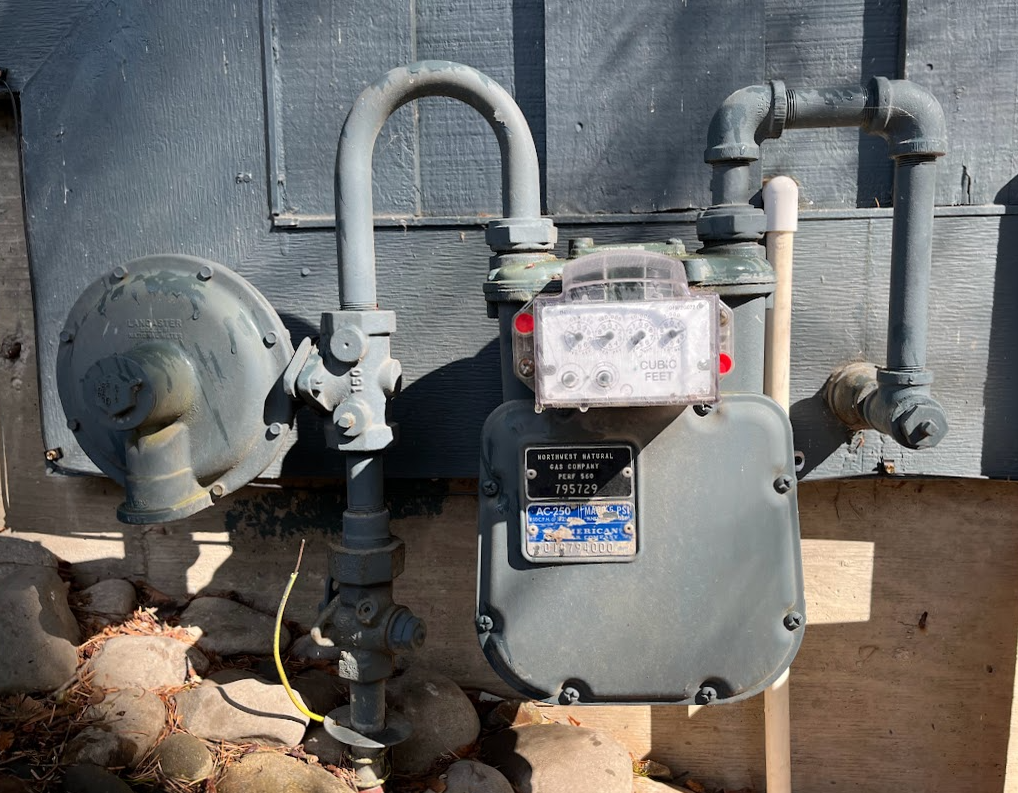
Natural gas is available through a quick connect outlet behind the utility room for the Weber grill and an outlet can be added at the meter on the east wall of the garage. The natural gas meter is the American Meter Company AC-250 that supplies 250 CFH @ ½ diff.
Natural gas appliances are the forced air furnace and water heater. Additionally, the Viking cooktop and the Weber grill are connected to the gas lines.
The forced air furnace has a max BTU of 125,000 or 125 cubic foot hour (CFH).
The water heater is 40,000 BTUH or 40 CFH.
One Viking burner uses 18 CFH and the Weber grill is 48 CFH.
As a reference, the Costco tri-fuel Firman generator uses 101 CFH at load.
The furnace and the water heater together use 165 CFH. With the Firman Generator, the total use would be 266 CFH. As a rule of thumb, natural gas use should not exceed double the rated CFH of the natural gas meter or 500 CFH.
A natural gas hookup can be installed at the service port on the right hand side of the gas meter.
1- ¾” to ¾” full port brass ball valve that is outdoor rated (125G)
1 - ¾” galvanized or black iron tee
5 - ¾” x 1” black iron nipple fittings
Z21.41 ¾” quick connect for natural gas
The goal is to provide continuous power for consecutive days with the flexibility of utilizing a variety of energy sources and fuels (battery, natural gas, propane, unleaded gasoline).
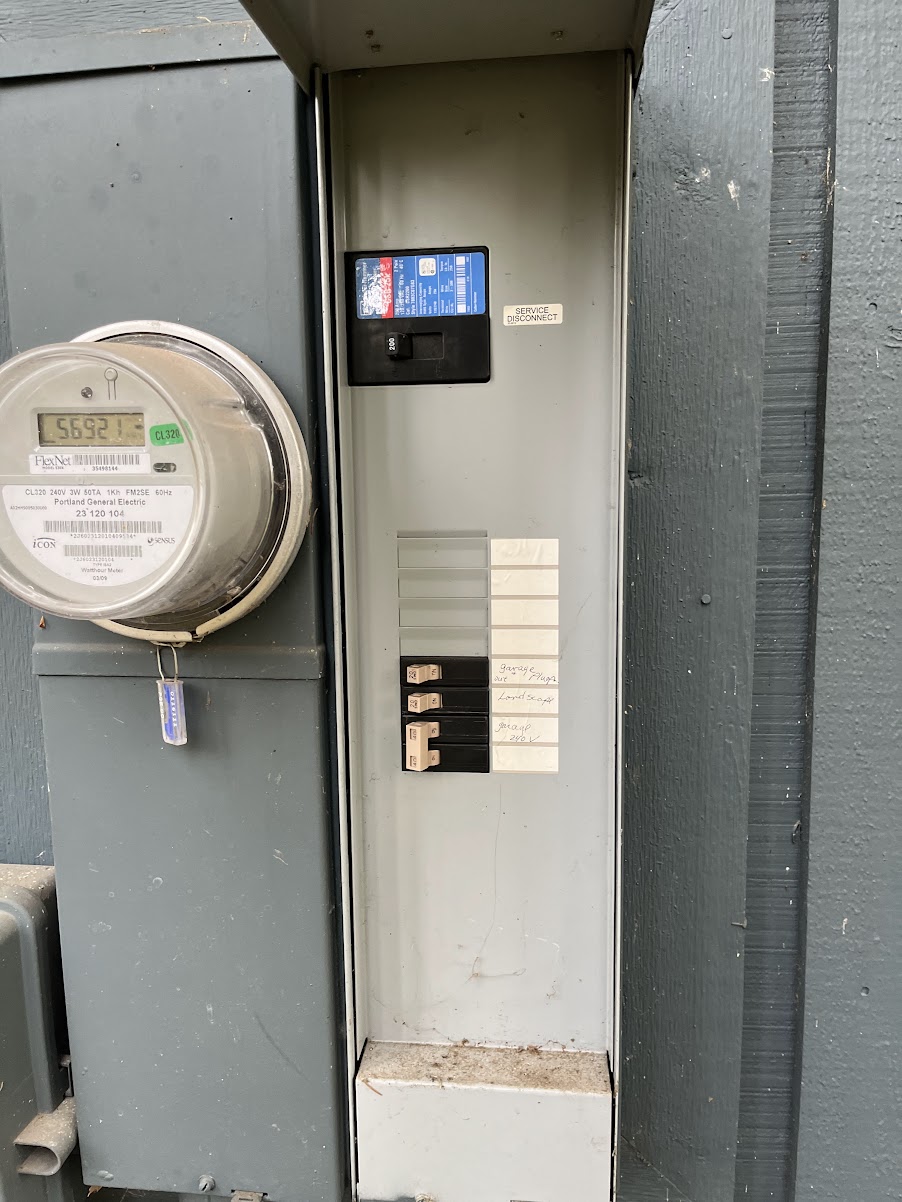
There are three main electrical panels: (1) outdoor garage panel, (2) indoor utility room main panel and (3) outdoor pump house panel.
Power comes from the power pole to an Eaton Cutler-Hammer 4-space 8-circuit BR type main meter breaker load center panel on the west garage wall. This panel has a 240V circuit breaker for the EV outlet, 120V for the garage and 120V for the front landscape lights. The neutral and ground are bonded here. Shutting off the main breaker will turn off power to the house completely. Adding a 50A 240V breaker and twist lock receptacle (NEMA SS2-50P) with an Eaton Cutler-Hammer interlock switch would be a simple solution to add a 240V generator inlet.
The natural gas meter is to the right of the garage panel that could provide natural gas to a tri-fuel generator. A new natural gas outlet at the meter will need to be installed for access.
The electrical panel in the utility room is the primary circuit breaker to control the majority of the home circuits. Shutting off the main breaker turns off power to the breakers in this panel including the pump house electrical panel.
Table 3.1: Observed and Estimated Power of large appliances
Voltage | Amps | Startup Watts | Continuous Watts | |
Baseline Power | 120V | - | - | 742W |
Well Pump | 240V | 9A | 4,670W | 2,104W |
Kitchen Refrigerator Freezer | 120V | 11A | 1240W | 285W 175W |
Kitchen Freezer | 120V | 175W | ||
Garage Refrigerator | 120V | 4.5A | 1154W | 255W |
Garage Chest Freezer | 120V | 1500W | 108W | |
NG Forced Air Furnace | 120V | 11A | 625W | 415/840WW |
Total Automated Loads with Baseline, No AC | 8,704W | 3,318W | ||
Air Conditioner | 240V | 40A | 29,036W LRA 6,832W soft start | 4,577W |
Total Automated Loads with Baseline with AC | 16,225W | 7,896W | ||
Non Automated Loads | ||||
EV Charger | 240V | 32A | - | 7,744W |
Washer/Dryer | 240V | 30A | - | 5,500W |
Dacor Double Oven | 240A | 37A | - | 4,700/8,600W |
The kitchen refrigerator has two compressors. The refrigerator compressor runs at ~118W and the combined refrigerator and freezer compressors runs at ~285W.
Baseline power includes network routers, network switches, mesh nodes and mini servers running DNS, home automation and media.
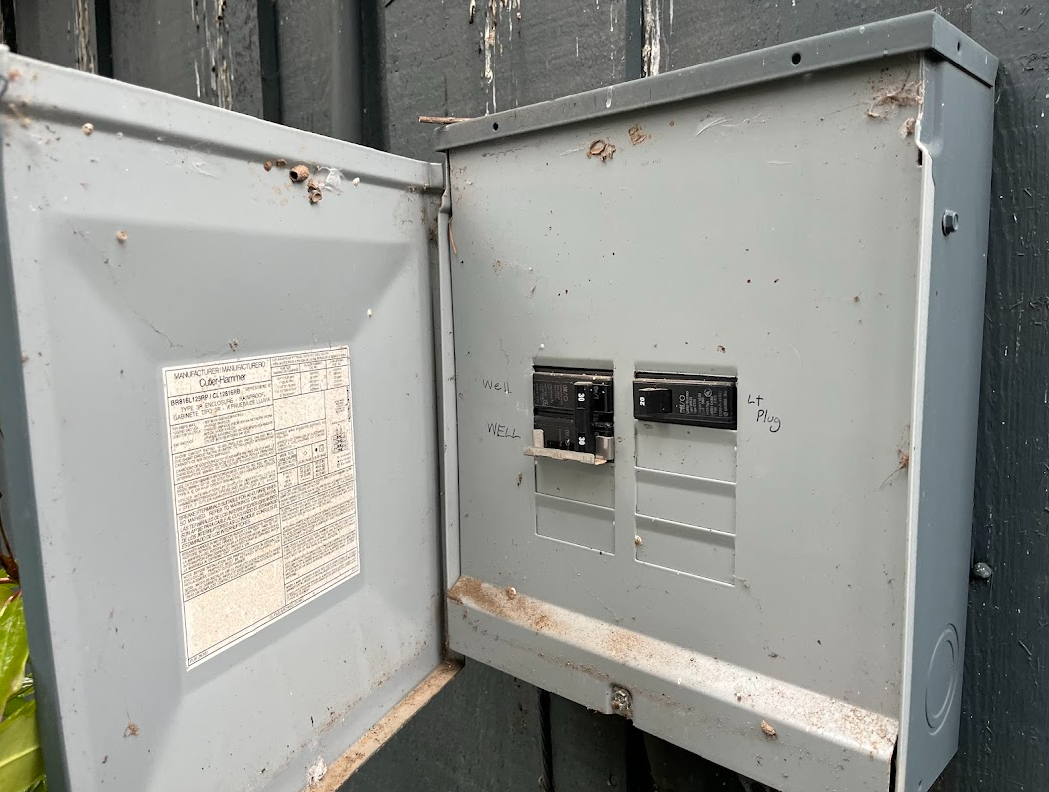
The pump house circuit breaker is 50A from the utility room electrical panel. The well pump is on a 240V 30A circuit breaker and there is a 20A circuit for the light plug and 120V receptacle. The barbecue natural gas outlet is available 15 feet south of the pump house electrical panel. A generator switch can be installed to switch power from house power to generator power.
At a minimum, provide power to run the well pump, refrigerators and furnace.
The well pump runs to fill the well reservoir tank . Power is 4,670W at startup and 2,057W continuous for 25 seconds. An exterior L14-30P 240v power inlet for a fuel generator or L14-30P plug for a battery based inverter.
Dual Fuel Inverter Generator: ~$500
2500/5000W Inverter: ~$450
2x 12V 100ah lead acid battery: ~$300
Bluetti AC180 1,152Wh power station to run the furnace
Bluetti EB70 716Wh power station to run the garage refrigerator and freezer.
Another power station will be needed to run the kitchen refrigerator.
Total cost would be $1550 for option 1 and the reality is that there are significant sunk costs for a marginal, hard to use manual system. Better to put that money into a single, easy to install, 240V whole house system.
Costco $899.99
Runs on gasoline 7500/9400W, propane 6750/8450W or natural gas 5500/6900W.
439cc engine with electric start, 8 gallon tank, 213 lbs at 74db ¼ load.
One L14-30R 120V/240V 30A twist lock or 14-50R 120/240V 50A plug.
This is not an inverter generator and outputs a modified sine wave with a THD in the 20-30% range that may degrade the life of the well pump, refrigerator/freezers and electronics.
Outputs 7600/9500 gas, 7200/8550 propane and 6100/7700 natural gas - Amazon $1,899.
240V L15/30P twist lock and 240V 50A LR14-50 connectors.
243lbs. No noise rating but received 5 stars from Amazon customers on noise.
3000Wh and larger battery storage storage solutions are eligible for a 30% federal tax rebate in 2024 (price reflected with parentheses).
All in one 240V inverter and 3,840 Wh of battery storage with 6,000W continuous.
The fastest charging option is with the 120V input at 1,800W but will shut off the 240V outlets. However, the 240V outlets will work if charged with the XT60 inputs. The XT60 inputs supports 11-60V. From 11-15V, up to 10A is supported, and from 16-60V, up to 27A is supported up to a maximum of 1,150W for each XT60 port.
Table 4.1: XT60 Input Voltage and Maximum Amperage (Anker Solix Firmware after 2.1.1)
Input Voltage | Maximum Amps |
11-15V | 10A |
16-60V | 27A |
$3,499 ($2,449.30)
120/240V split phase, 6,000 W, 3,840Wh LFP and 5 year warranty, 132.3lbs
3840Wh expansion with the Anker SOLIX BP3800 for $1,799 for a total of 7,680Wh of storage for $5,298 ($3,708.70)
Kickstarter price for unit was $2,599 (until Nov 14, 2023) and introductory price was $2,999 (until Jan 14, 2023)
Black Friday 2024 price of $2,099 ($1,469.30) at Wellbots.com
2x Pecron E3600LFP 120v, 3072Wh/6144Wh LFP, 7200W total.
$1,529 x 2 = $3,058 + $159 for the 240V adapter.
November 2024 Black Friday price of $1,359 and $139 for the adapter. 5% discount with the solar lab coupon code. $2,582.10 + 139 = $2,721.10 ($1,904.77)
EP3000 3072Wh battery for $845.05 ($0.275 /Wh)
The Pecron F5000LFP was demonstrated at CES 2025 is a 5kWh, 240V single unit solution with a 7200W inverter.
Growatt 5kW Off-Grid, SPF5000T-ES, high freq inverter: $699
5kW nominal power output with 10kW surge
93% charge/discharge efficient, 10-20ms switch time, 26.5lbs
EG4 6000XP high freq Inverter: $1,399
6kW nominal power output with 11kW surge for 5s
93% charge/discharge efficient, 15ms switch time, 50W idle, 52.9lbs
EG4-LifePower4 48v, 5120Wh: $1,259 ($0.246 /Wh)
Product: price - 6% discount = sale price = total price (cost with tax credit)
2 Growatt SPF5000T-ES and 15.36kWh LFP: $5,277 - $316.62 = $4,910.38 ($3,437.27)
6kW EG4 6000XP inverter and 15.36kWh LFP: $5,176 - $310.56 = $4,865.44 ($3,405.81)
12kW 2 EG4 6000XP inverter and 15.36kWh LFP: $6,575 ($4,602.50)
2 5kW 48V All in One Parallel Solar Charger Inverter $1,599.90
10kW 48V Hybrid Solar Charger Inverter (Single/Split Phase) $1,699
51.2V 100Ah Smart LFP with Mounting Tray Bracket $1,486.40
2 48V/51.2V Smart LFP Battery Rack $2,777.85
3 48V/51.2V Smart LFP Battery Rack: $4,136.80
10kW Inverter and 15.36kWh LFP: $5,835.80 ($4,085.06)
10kW (15.9kW max) AOlithium 3 Phase Inverter 380v/400V: $1,899.99
3 100Ah 51.2V LFP: $3,266.99
10kW inverter and 15.36kWh LFP: $5,166.98 ($3,616.89)
13kWh NMC $5,199 ($3,639)
Vendor from Alibaba China. Duty, Delivery Paid (DDP) is approximately 27% of cost
LFP Batteries:
51.2V 100ah $690
51.2V 150ah $967
51.2V 200ah $1160.
Inverters:
6kW low frequency Growatt SPF 6000T DVM-MPV split phase off grid inverter:$760/pc
6kW rated power with 18kW surge
85% efficient, 10ms switch time, 114.6lbs
8kW Growatt split phase off grid inverter: $1275/pc
6kW hybrid inverter (split phase) Unit price:$1651/pc
10kW hybrid inverter(split phase) Unit price:$1993/pc
10kW off grid inverter(split phase)Unit price:$2319/pc
Inverter | Storage | Price: Inverter+Battery+DDP | Price after Tax Credit |
Growatt 6kW SPF 6000T DVM-MPV | 10.25kWh | $760+$1380+577.80 = $2717.80 | $1902.46 |
Growatt 6kW SPF 6000T DVM-MPV | 15.38kWh | $760+$2070+$764.10 = $3594.10 | $2515.87 |
2xGrowatt for 12kW SPF 6000T DVM-MPV | 15.38kWh | $1520+2070+969.30 = $4559.30 | $3191.51 |
November 2024 Black Friday price of $2,099 from Wellbots.com.
Not purchased was the BP3800 3,840 Wh battery price at $1,679 ($0.437 /Wh)
Table 5.1: XT60 Input Voltage and Maximum Amperage (Anker Solix Firmware after 2.1.1)
Input Voltage | Maximum Amps |
11-15V | 10A |
16-60V | 27A |
The Pecron DC1242-500 converts 12VDC to 42VDC up to 500W. This connects to a car battery’s positive and negative terminals and connects through MC4 adapters into the Anker Solix or Pecron E1000LFP XT60 DC inputs.
Tested with the VW ID.4 and charged the Pecron E1000LFP at 580W for one hour.
Purchased from Amazon on March 21, 2025 for $149.
Variable 39.17-57.64V DC.
In the first test run, the output voltage was set to 55.95V and measured 1,332W (23.8A) at the outlet. Input power to the Anker Solix was 1,150W for an efficiency of 86.3%.
Purchased from Surplus Gizmos on January 31, 2025 for $125
Purchased refurbished from the Firman Direct store on eBay on April 8, 2025 for $359.99.
193cc engine with electric and recoil start. 4000W peak, 3200W continuous with gasoline. 3750W peak, 3000W continuous with propane.
Purchased from Amazon on February 1, 2025 for $399.59. Returned due to its inability to provide the listed 1,600W continuous power on propane.
Gasoline: 2,200W peak, 1,800W continuous. LPG: 1,800W peak, 1,600W continuous.
The actual peak before the generator stalls is 1,050W and unable to provide enough AC power to the Meanwell power supply. The Meanwell output voltage was reduced to the minimum 39.17V but still required about 1,250W during spin up which stalled the Pulsar generator.
Optimal load efficiency of an inverter generator is 50-75%. According to Amazon reviewers, one gallon of gas should last eight hours and a 20lb propane tank should last ten hours.
Table 5.2 Cost Table
Item | Cost |
| $2,099.00 |
| $149.00 $7.99 $12.74 |
| $125.00 $359.99 |
| $15.99 $16.99 $25.99 $12.99 $13.99 |
| $80 $35 $80 $60 $70 $325 |
Total | $2,471.95 + $325 |
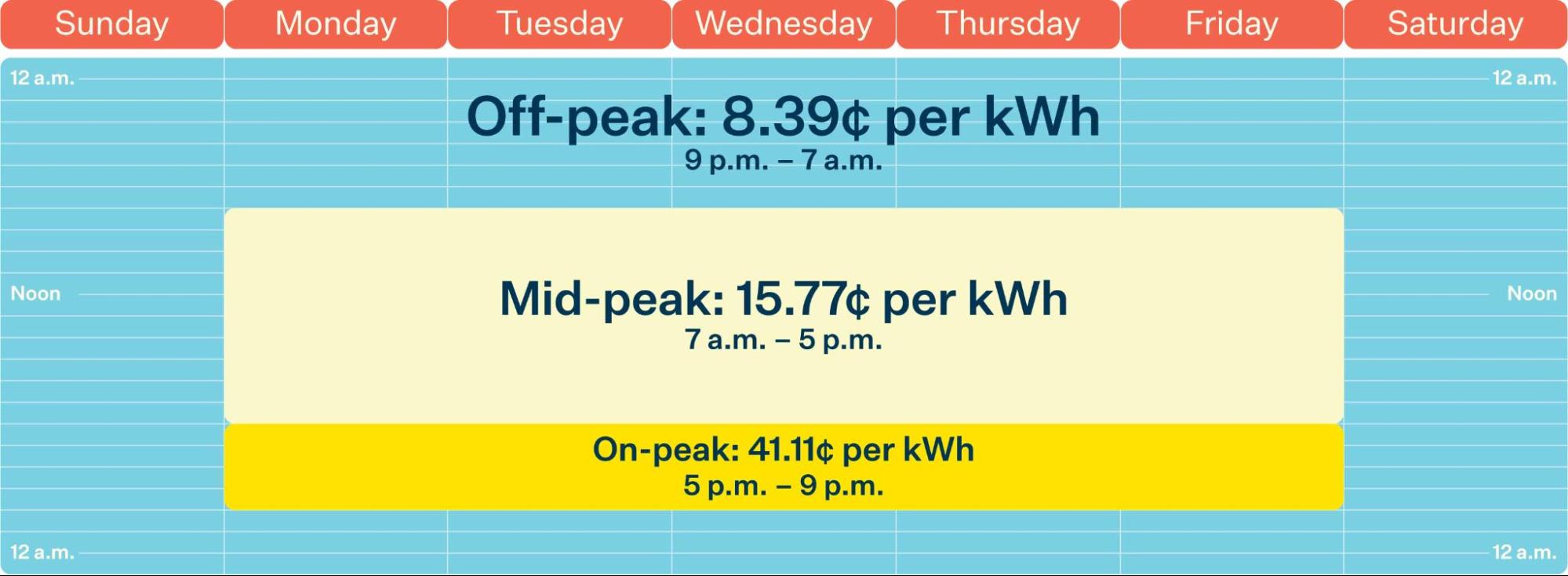
With Portland General Electric’s (PGE) Time of Day rate schedule, a battery energy store can be used during On Peak times and charge the battery during Off Peak times thus avoiding energy use from the grid during the most expensive On Peak times. This battery storage with inverter will require enough power (Inverter kW Rated Power and Surge Rating) and energy storage (Battery kWh) from 5pm to 9pm on weekdays, excluding PGE energy holidays. The inverter should automatically switch from grid power to inverter power at the start of the On Peak period and vice-versa at the end of the On Peak period. Additionally, the switch should be a seamless switchover with no loss of power in the transition.
Enough power to run all automated loads during On Peak time and enough energy storage to last the four hours are the requirements to determine the Inverter size and battery storage needs. Unautomated loads like EV charging, clothes dryer and dishwasher should be avoided during On Peak times. However, with no data after time of day modified behavior in the hot summer months with the central air conditioner, we can surmise adding a 4500W air conditioning load to our existing November/December Time of Day data. A soft start device should reduce the surge rating to 7.5kW from 25kW. Data to support recommendations in detail in section VII of this document.
A low frequency inverter with a power rating of at least 9kW with a surge rating of at least 18kW surge rating should provide the requisite power needs during On Peak times.
10kWh of battery storage may suffice for On Peak times but having 15kWh of storage may extend battery longevity and partially address extenuating energy usage such as consecutive extreme hot days as was the case on Aug 14-16 (106F, 102F, 103F).
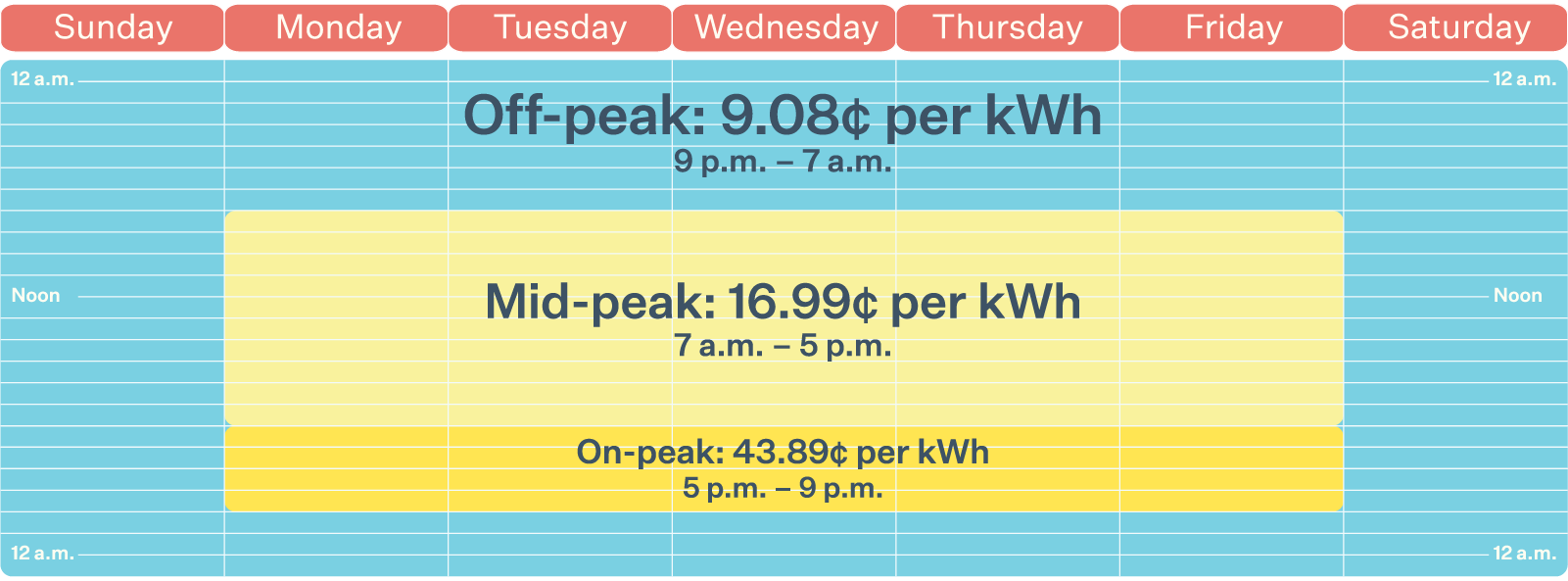
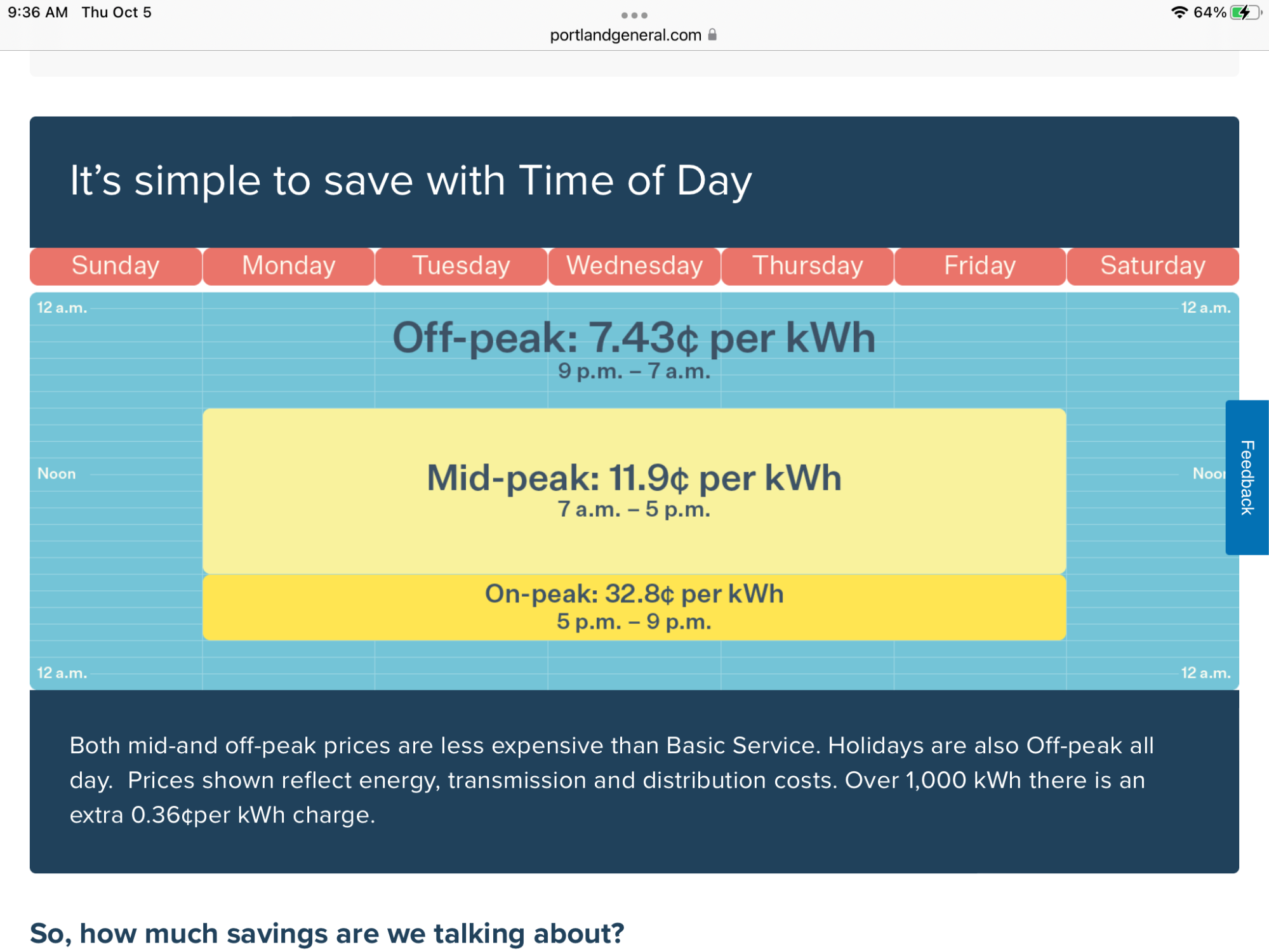
PGE’s Time of Day program has three rates based on time of day on weekdays and non PGE holidays. Weekday, non PGE holiday prices from 5p-9p are $0.4389 per kWh and 7a-5p are $0.1699 per kWh. All other times are $0.0908 per kWh (9pm-7am weekdays and weekends, and six holidays). The basic rate is $0.2089 per kWh.
Table 7.1: PGE Time of Day Pricing Schedule
Table 7.2 PGE Off-peak Holidays
Wrote a python script to consolidate PGE 15 minute power data into PGE Time of Day segments used for a data driven approach on how much power and energy is required to better utilize the Time of Day pricing with using stored energy during peak times and charge during off peak times.
With normal energy use behavior, the cost savings of using stored energy during peak times at 80% round trip battery charging/discharging efficiency was $806 in 2023, $884 in 2022 and $785 in 2021 though we did switch our energy use behavior from November 1, 2023 when we started PGE’s Time of Day pricing program. With the changed energy use behavior in November and December, the savings was $78.49 for the two months or projected to $471 per year.
Energy use during peak times provides data on how much energy storage is necessary to time shift energy use during peak times. In 2023, 115 out of 255 days (weekdays, excluding six designated PGE electricity holidays) or 45.1% were over 10kWh. 40/255 15.7% were over 15kWh, 12/255 4.7%, 2/255 0.7% was over 25kWh and August 16, 2023 (104F) used 35.8kWh after three consecutive 100F plus degree days. From November 1 to December 31, 2023, there were zero days above 10kWh with an average of 6.25kWh.
The changed energy behavior was not running the washer/dryer and dishwasher as well as no EV charging during On Peak hours. The following table shows a 78% reduction in On Peak energy use before and after the changed energy behavior. Energy use during Off Peak increased 35% at night and 18% in the morning. In the end, the total energy usage was approximately the same.
Table 7.3: Before and After Time of Day Energy Usage (2023 - 2024)
kWh per time slot | Off Peak AM | Mid Peak AM | Mid Peak PM | On Peak | Off Peak PM | Total Usage |
Before TOD Jan to Oct | 10.05 | 8.59 | 8.97 | 11.11 | 7.99 | 46.71 |
After TOD Nov to Dec | 12.07 | 7.33 | 8.36 | 6.25 | 12.31 | 46.32 |
% Change | +18% | -17% | +7% | -78% | +35% | -1% |
To calculate the kW power needs of a whole house inverter, the most granular data available from PGE are at 15 minute increments. The biggest concern would be the simultaneous startup of loads that are automatically controlled by pressure switch or thermostat. Near worst case scenario would require an 8kW inverter with 25kW peak capacity or 16kW peak with a soft start device for the air conditioner.
Table 7.4: Startup and Continuous Power of Baseline Power with the Largest Automated Loads
Device/Power in Watts | Startup W | Continuous W |
Baseline | 800 | 800 |
Well Pump | 4670 | 2057 |
HVAC Blower Fan (Heat or Cool) 4-ton Air Conditioner | 1250 25070 LRA 7521 Soft Start | 1150 (stage 2) 4577 |
Kitchen Refrigerator | 1240 | 256 |
Garage Refrigerator | 544 | 146 |
Total | 15525 | 8466 |
The following table shows the highest 15 minute energy usage segment during Time of Day pricing.
Table 7.5: Highest Off Peak 15 minute Energy Usage from Nov 2023 to Dec 2023
Date | Start | End | Usage (kWh) | Cost |
2023-12-31 | 20:45 | 20:59 | 1.76 | $0.12 |
2023-12-31 | 19:30 | 19:44 | 1.36 | $0.09 |
2023-12-30 | 18:45 | 18:59 | 1.29 | $0.09 |
2023-12-30 | 19:00 | 19:14 | 1.23 | $0.08 |
2023-12-30 | 18:30 | 18:44 | 1.11 | $0.08 |
2023-12-31 | 19:45 | 19:59 | 0.86 | $0.06 |
2023-12-30 | 17:00 | 17:14 | 0.8 | $0.05 |
2023-11-03 | 17:00 | 17:14 | 0.77 | $0.15 |
2023-11-04 | 20:45 | 20:59 | 0.71 | $0.03 |
2023-12-22 | 19:45 | 19:59 | 0.67 | $0.21 |
Table 7.6: kWh instances in 15 minute increments for November 2023 to December 2023
kWh Range | Instances | kWh Range | Instances | |
3.2 to 3.29 | 1 | 2.6 to 2.69 | 7 | |
3.1 to 3.19 | 2 | 2.5 to 2.59 | 11 | |
3.0 to 3.09 | 2 | 2.4 to 2.49 | 27 | |
2.9 to 2.99 | 6 | 2.3 to 2.39 | 59 | |
2.8 to 2.89 | 2 | 2.2 to 2.29 | 65 | |
2.7 to 2.79 | 4 | 2.1 to 2.19 | 42 | |
2.0 to 2.09 | 15 |
The top seven high energy segment use was the evening of August 16 that was the third day and final day of consecutive 100F days with a low temperature of 69 (Aug 14), 73 (Aug 15) and 71 (Aug 16) that didn’t allow for much cooling at night. Interestingly, the next three were on Dec 22 and Jan 12. Dec 22 was a Friday after Peak Time and likely did a load of laundry and ran the dishwasher.
Table 7.7: Highest 15 minute Usage For 2023:
DATE | START TIME | END TIME | USAGE (kWh) | COST |
2023-08-16 | 21:00 | 21:14 | 3.69 | $0.10 |
2023-08-16 | 21:15 | 21:29 | 3.63 | $0.04 |
2023-08-16 | 20:00 | 20:14 | 3.55 | $0.13 |
2023-08-16 | 19:45 | 19:59 | 3.52 | $0.22 |
2023-08-16 | 20:15 | 20:29 | 3.37 | $0.10 |
2023-08-16 | 20:45 | 20:59 | 3.35 | $0.13 |
2023-08-16 | 20:30 | 20:44 | 3.28 | $0.09 |
2023-12-22 | 21:45 | 21:59 | 3.24 | $0.22 |
2023-01-12 | 18:30 | 18:44 | 3.21 | $0.39 |
2023-01-12 | 18:15 | 18:29 | 3.18 | $0.38 |
2023-07-23 | 20:45 | 20:59 | 3.18 | $0.06 |
2023-08-05 | 21:00 | 21:14 | 3.12 | $0.07 |
2023-11-18 | 17:30 | 17:44 | 3.12 | $0.21 |
2023-11-18 | 17:45 | 17:59 | 3.11 | $0.21 |
2023-01-12 | 20:45 | 20:59 | 3.07 | $0.37 |
2023-07-15 | 15:15 | 15:29 | 3.06 | $0.11 |
2023-08-15 | 21:00 | 21:14 | 3.05 | $0.04 |
2023-08-21 | 19:45 | 19:59 | 3.05 | $0.32 |
2023-02-08 | 18:30 | 18:44 | 3.04 | $0.36 |
2023-07-15 | 15:00 | 15:14 | 3.04 | $0.08 |
2023-04-22 | 17:15 | 17:29 | 3.03 | $0.06 |
2023-08-25 | 18:45 | 18:59 | 3.03 | $0.06 |
2023-08-26 | 13:00 | 13:14 | 3.03 | $0.15 |
2023-08-26 | 13:15 | 13:29 | 3.03 | $0.15 |
2023-08-26 | 12:45 | 12:59 | 3.02 | $0.15 |
2023-11-16 | 21:30 | 21:44 | 3.02 | $0.16 |
2023-08-05 | 21:15 | 21:29 | 3.01 | $0.04 |
2023-12-17 | 12:30 | 12:44 | 3.01 | $0.20 |
Published energy off-peak holidays from Portland General Electric:
2023 Basic Residential Rate is $0.1874 per kWh
2024 Basic Residential Rate is $0.1945 per kWh
2025 Basic Residential Rate is $0.2089
Page